ISS

ISS
The final frontier.
Showing posts with label space junk. Show all posts

Monday, January 2, 2012

China's Space Plans

Last week, the Chinese government released a 17 page white paper document entitled, "China's Space Activities in 2011."  The paper is a brief summing up of the last five years in Chinese space activities, and a preview of what to expect in the next five year space program.  While the paper isn't mind blowing in its scope or material, it does touch on some interesting points.

The accomplishments of the Chinese space program have been impressive in the last five years, and the paper focuses on the most noteworthy achievements.  Since 2006, the Long March series of rockets, China's workhorse, has had 67 successful launches, making it one of the world's most reliable launch systems.  In 2007 and 2010, China launched Chang'e-1 and Chang'e-2, respectively, which marked the nation's first serious foray into deep space exploration.  Both spacecraft successfully orbited, mapped, and studied the Moon. In 2008, China successfully launched three men aboard Shenzhou-7, a mission that saw the country's first spacewalk.  And, most recently, China launched its first space lab, Tiangong-1, and successfully remotely docked a Shenzhou spacecraft with the orbiting lab.  The paper also mentions a few scientific accomplishments, like experiments in physics and materials sciences.

Chinese astronaut, Zhai Zhigang, waves to the camera during his 2007 spacewalk (BBC).


The paper goes on to lay out a general plan for China's space program for the next five years.  A continuation of the space lab program, in preparation for a full-fledged space station is highlighted.  This next year will see another unmanned docking with Tiangong-1, as well as one manned mission to the lab.  The Chinese lunar program will move forward as well, with a plan to do a soft landing, followed by a lunar rover, and culminating in a soil return mission.  China will also develop several new rockets in its Long March series, including a "heavy lift" variant which proposes to launch 25 tons into low Earth orbit.


Possible configurations of the proposed Long March 5 family of rockets (Jirka Dlouhy).

One of the surprising things about the document is how much emphasis is put on international cooperation.  Every international space agreement China has entered into is detailed, from commercial deals with the developing world, to multi-national science missions with Europe, to Russia's cooperation with China on their manned program.  This could be a sign that China is opening up more, and by highlighting the work they have already conducted with other nations, they hope to cozy up to bigger space partners (maybe the US?).

Not surprisingly, there are some inconsistencies with what the Chinese government says, and what it does.  The paper highlights China's efforts to mitigate and track space debris.  However, in 2007 the Chinese tested an anti-satellite weapon, destroying one of their own aging weather satellites.  This incident created over 2,300 pieces of trackable space debris.  While this stunt may have demonstrated China's satellite killing ability to the world, it created more space debris than any other single event in history.  Debris from this incident has already threatened the ISS once, and will continue to be a problem for all space faring nations decades to come.

Propaganda aside, China is indeed pushing forward in all aspects of their space program, and this latest document is an interesting glimpse of where China is headed in space.  Let's hope they keep to their commitment of greater international cooperation, an increase in space science, and a reduction in dangerous space debris.

Read the full text of the white paper, here.

Saturday, September 3, 2011

Space Junk Threatens Man and Machine

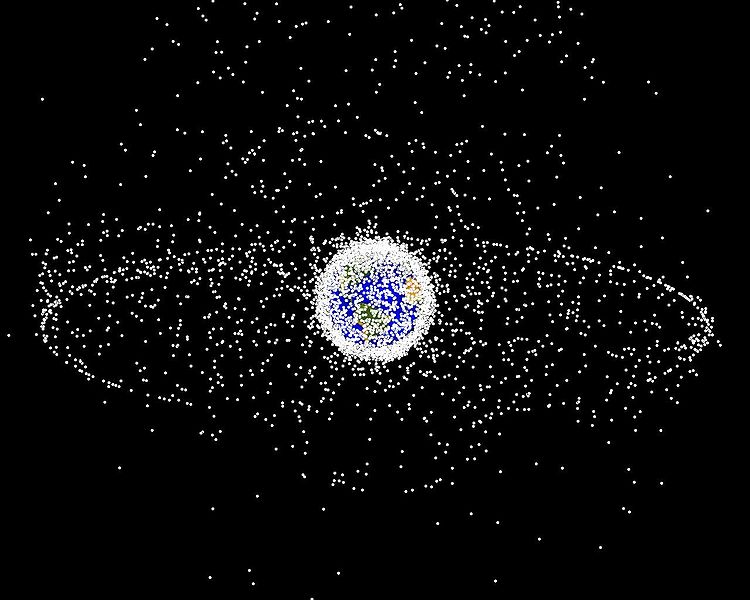
The space around Earth is a lot less empty than it used to be.  With hundreds of operational satellites, the International Space Station, manned space vehicles, and unmanned cargo ships, it seems things can get pretty crowded up there.  However, the vast majority of objects in orbit around Earth is not functioning satellites or housing for astronauts, it's space junk.


A map showing space debris populations in Earth orbit (NASA).

Space junk, or space debris, comes from a variety of sources.  Derelict satellites, discarded upper stage rocket engines, and fragments from explosions and collisions circle the world in both low Earth orbit and higher, geosynchronous orbits.  A satellite can remain in orbit for years after it stops functioning.  Vanguard 1, the first solar powered satellite, was put into a medium Earth orbit in 1958 and ceased communicating with ground controllers in 1964.  Yet, this now useless relic will remain in orbit for another 240 years.

The problem with all this space debris is that it is starting to pose a real threat to operational satellites and humans in Earth orbit.  The European Space Agency estimates there are over 600,000 objects in orbit that are larger than 1 cm.  And when traveling at over 23,000 kph, even a fleck of paint can cause a catastrophe when it collides with, say, the International Space Station.


A fleck of paint smashed into Challenger's window, causing this crater on shuttle mission STS-7 (NASA).

The situation isn't getting better any time soon, either.  Some experts now think that we have reached a tipping point, where there is now so much debris that objects will begin colliding with each other creating more debris at an exponential rate.  If that is indeed the case, it might soon be impossible for humans to safely travel into orbit, or even loft a satellite without the danger of it being obliterated in a vast sea of deadly space junk.  Indeed, just two years ago a defunct Russian satellite collided with a US communications satellite, destroying both and creating an extra 2,000 pieces of debris.

Mitigating the danger from space debris has already become a priority at NASA and in the international space community.  Ground based radar stations track much of the debris, but pieces under 10 cm can be difficult to detect with radar.  Knowing where the junk is can help astronauts be prepared for potential disasters, or help them know where to maneuver spacecraft to avoid a collision.  And now, after satellites have completed their operational lives, many are purposefully put into a decaying orbit that can cut down the time they will remain in orbit by decades.


The Goldstone antenna is capable of detecting debris as small as 2mm (NASA).

These steps may not be enough, however.  There are several plans in the works to actively "de-junk" space.  One plan, called the ElectroDynamic Debris Eliminator (EDDE), involves sending up cheap, lightweight satellites that use Earth's magnetic field for power and propulsion.  These satellites would be equipped with deployable nets to ensnare pieces of space junk, and drag the debris down to a decaying orbit.  Another plan involves moving debris into orbits that don't intersect with today's working satellites by using lasers.  A stream of photons impacting on a small piece of debris could move it up to 1 mm per second.  While that may not seem like a lot, over the course of several days that could add up to kilometers.

Whatever action is decided upon, certainly this clean-up effort will need to be an international one.  Dozens of nations operate satellites, and even the derelict satellites are still property of the nations that sent them up there.  Let's hope the space community comes to a swift decision, and implements a solution soon.  Space is risky enough as it is, removing the threat of space debris will be a big step toward sustaining a safer environment for satellites and astronauts.

Read more about space junk.