ISS

ISS
The final frontier.

Saturday, October 22, 2011

Russia Sets its Sights on Phobos

Russia is finally getting back into the game - the interplanetary space exploration game, that is.  Next month, Russia is set to launch their first interplanetary probe in 15 years.  And if all goes according to plan, it promises to be an extraordinary mission.  The Phobos-Grunt spacecraft consists of a lander that also acts as an orbiter.  Once in Martian orbit, the spacecraft will study both Mars and Phobos for several months, and after a suitable landing place has been found, it will descend to the surface of Phobos.  Once there, it will conduct a thorough scientific investigation of the surface and then collect a soil sample, seal the sample in a return capsule, and blast it back to Earth.  A sample return mission has never been attempted for Mars or either of its moons, so this is really an ambitious and exciting mission.


The Phobos-Grunt spacecraft.

Mars has two moons, Phobos and Deimos.  Both are tiny, and are thought to be asteroids that were captured by Mars's gravity.  By contrast, our own Moon was most likely formed when a planetoid object collided with the early Earth, and the debris coalesced into the Moon.  A soil sample from Phobos will undoubtedly confirm the asteroid-capture theory.


Phobos as seen from the Mars Express spacecraft (ESA).

Russia's last interplanetary mission, Mars 96, ended in complete disaster.  Planned to be an orbiter and two landers, Mars 96 failed to escape Earth orbit, and burned up over the Pacific.  If Phobos-Grunt can succeed, it will certainly be a feather in the cap of Russia's space agency, and a leap forward in our understanding of how the Mars system formed.  France's space agency, CNES, is partnering with Russia on Phobos-Grunt, and has contributed some of the scientific instrumentation aboard the spacecraft.


Artist's rendition of Phobos-Grunt lander with sample return capsule detached at top.

Along for the ride with Phobos-Grunt is a small, Chinese satellite, named Yinghou-1.  It will be China's first spacecraft to the Red Planet.  It will be released into Martian orbit, and have a scientific mission to study the Martian gravitational and magnetic fields for about a year.

Read what NASA has to say about Phobos-Grunt, here.

Sunday, September 11, 2011

Twin GRAIL Probes Head to The Moon

NASA is headed back to the Moon!  Not with people, mind you, but with two very high tech spacecraft.  Yesterday morning, the GRAIL (Gravity Recovery and Interior Laboratory) mission successfully launched from Cape Canaveral atop a Delta 2 rocket.  The mission involves two nearly identical spacecraft, Grail-A and Grail-B, which are now headed, at a slow pace, to the Moon.


The Delta 2 rocket carrying the GRAIL spacecraft rises from Cape Canaveral (NASA).

The GRAIL mission is a fascinating one.  Its purpose is to construct a 'gravity map' of the Moon.  The 'gravity map' will tell scientists what parts of the Moon have a greater or weaker gravitational pull.  Knowing this information will not only reveal the make-up of the Moon's interior, but will help future spacecraft enter into more exact orbits, and aid in the landing of lunar probes.  As part of NASA's Discovery Program (promoting science missions on the cheap), costs were kept to a minimum, and that meant keeping the washing machine-sized spacecraft light on fuel.  The GRAIL craft will take nearly four months to reach the Moon - a trip that the Apollo missions made in three days.  As they approach the Moon, around New Year's Day, the spacecraft will maneuver into tandem orbits, and fly the duration of their mission in formation.  By keeping in constant radio contact with one another, and Earth based antennae, even the slightest perturbations in the crafts' orbits will be detectable.  The greater the disturbance of the orbit, the greater the gravitational pull any given point on the lunar surface is exerting on the spacecraft.  Voila, you've got a gravity map of the Moon.

Okay, so it isn't quite that simple, but that's the basic premise.  The actual maneuvering of the spacecraft into their exact orbits will be an unprecedented feat.  Two craft have never been put into tandem orbits like this around another planet, which is another reason the craft are taking their time to get to the Moon.  Small adjustments to the crafts' trajectories will be made over the coming months, so that when they reach lunar orbit, they will be ready for their formation flying.


An artist's rendition of the GRAIL spacecraft communicating with each other and the Earth (NASA/JPL).

Each GRAIL spacecraft will also be equipped with a MoonKAM (Moon Knowledge Acquired by Middle school students).  Students participating in the program will be able to pick out features on the lunar surface, and then photograph them using the cameras.  This is the first time NASA has launched an instrument with the express purpose of public outreach.

The successful launch of the GRAIL mission comes at a fortuitous time.  In the past three weeks there have been three major spacecraft launches; two by Russia, and one by China.  They all failed.  Not to mention the recent failure of a suborbital launch test by private space firm, Blue Origin.  I don't take pleasure in any of these failures, but it is nice to be reminded of NASA's dominance.  Even in the face of fickle funding, and sometimes waning public interest, NASA continues to succeed.  They employ some of the best engineers and scientists in the world, and NASA's budget is almost equal to the budgets of every other national space agency combined.  NASA leads in space science and in achieving amazing technological feats, and that isn't changing anytime soon.

Saturday, September 3, 2011

Space Junk Threatens Man and Machine

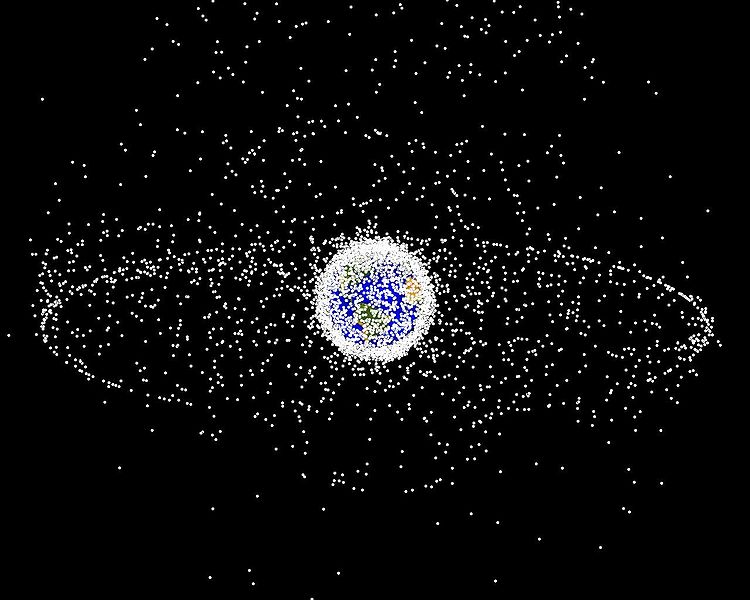
The space around Earth is a lot less empty than it used to be.  With hundreds of operational satellites, the International Space Station, manned space vehicles, and unmanned cargo ships, it seems things can get pretty crowded up there.  However, the vast majority of objects in orbit around Earth is not functioning satellites or housing for astronauts, it's space junk.


A map showing space debris populations in Earth orbit (NASA).

Space junk, or space debris, comes from a variety of sources.  Derelict satellites, discarded upper stage rocket engines, and fragments from explosions and collisions circle the world in both low Earth orbit and higher, geosynchronous orbits.  A satellite can remain in orbit for years after it stops functioning.  Vanguard 1, the first solar powered satellite, was put into a medium Earth orbit in 1958 and ceased communicating with ground controllers in 1964.  Yet, this now useless relic will remain in orbit for another 240 years.

The problem with all this space debris is that it is starting to pose a real threat to operational satellites and humans in Earth orbit.  The European Space Agency estimates there are over 600,000 objects in orbit that are larger than 1 cm.  And when traveling at over 23,000 kph, even a fleck of paint can cause a catastrophe when it collides with, say, the International Space Station.


A fleck of paint smashed into Challenger's window, causing this crater on shuttle mission STS-7 (NASA).

The situation isn't getting better any time soon, either.  Some experts now think that we have reached a tipping point, where there is now so much debris that objects will begin colliding with each other creating more debris at an exponential rate.  If that is indeed the case, it might soon be impossible for humans to safely travel into orbit, or even loft a satellite without the danger of it being obliterated in a vast sea of deadly space junk.  Indeed, just two years ago a defunct Russian satellite collided with a US communications satellite, destroying both and creating an extra 2,000 pieces of debris.

Mitigating the danger from space debris has already become a priority at NASA and in the international space community.  Ground based radar stations track much of the debris, but pieces under 10 cm can be difficult to detect with radar.  Knowing where the junk is can help astronauts be prepared for potential disasters, or help them know where to maneuver spacecraft to avoid a collision.  And now, after satellites have completed their operational lives, many are purposefully put into a decaying orbit that can cut down the time they will remain in orbit by decades.


The Goldstone antenna is capable of detecting debris as small as 2mm (NASA).

These steps may not be enough, however.  There are several plans in the works to actively "de-junk" space.  One plan, called the ElectroDynamic Debris Eliminator (EDDE), involves sending up cheap, lightweight satellites that use Earth's magnetic field for power and propulsion.  These satellites would be equipped with deployable nets to ensnare pieces of space junk, and drag the debris down to a decaying orbit.  Another plan involves moving debris into orbits that don't intersect with today's working satellites by using lasers.  A stream of photons impacting on a small piece of debris could move it up to 1 mm per second.  While that may not seem like a lot, over the course of several days that could add up to kilometers.

Whatever action is decided upon, certainly this clean-up effort will need to be an international one.  Dozens of nations operate satellites, and even the derelict satellites are still property of the nations that sent them up there.  Let's hope the space community comes to a swift decision, and implements a solution soon.  Space is risky enough as it is, removing the threat of space debris will be a big step toward sustaining a safer environment for satellites and astronauts.

Read more about space junk.

Sunday, August 28, 2011

Oregon Company Flies High

It isn't often that Oregon makes space news, so I found this to be a real treat.  NASA recently awarded contracts to seven private companies to carry scientific payloads to suborbital space.  One of those companies, Near Space Corporation (NSC), is based out of Tillamook, Oregon.  Okay, so they aren't exactly going into space - NSC builds and launches high altitude balloons.  Very high altitude.  They can launch a payload of over 1300 kg up to an altitude of about 40 km.  That's 130,000 feet.  That's above 99.9% of Earth's atmosphere, and while it isn't quite space, it is high enough to interest NASA.


Near Space Corporation preparing for a balloon launch near Tillamook, Oregon (NSC).

NSC has, in fact, already done some work for NASA, the Jet Propulsion Lab, and the National Oceanic and Atmospheric Administration.  They've done high altitude payload drops to simulate the thin Martian atmosphere, and are even designing a dirigible for use in the methane rich atmosphere of the Saturnian moon, Titan.

And while the other companies that NASA is contracting (including Virgin Galactic and Masten Space Systems) operate rockets to launch payloads to higher, suborbital space, putting scientific equipment on balloons does have its advantages.  Balloons can remain aloft for days at a time, allowing for a longer exposure to near space conditions than a single rocket launch, and for a fraction of the cost.

I'm glad Oregon is finally getting into the space mix.  Hopefully, NSC will allow NASA to get some science done on the cheap, while bringing a little attention to the Beaver State.  With luck, this will be just the beginning of Oregon's role in the burgeoning private space industry.

Saturday, August 27, 2011

The James Webb Space Telescope

The James Webb Space Telescope (JWST for short) has been making headlines lately, and for all the wrong reasons.  Recently, the House Appropriations Committee explicitly recommended the cancellation of the project, due to massive cost overruns.  It was revealed that the final cost of the telescope will be $8.7 billion - that covers the telescope's development, launch, and operation for five years in Earth orbit.  That is nearly four billion dollars more that was originally slated for the project.  That's a lot of money.  So what is the JWST, and why should we pay so much for it?


Artist's rendition of the James Webb Space Telescope (NASA).

The JWST, which was initially planned in 1996, is the heir apparent to the world's current most dazzling space telescope, the Hubble.  Named after a former NASA administrator, JWST promises to be the top of the line space telescope for the 21st century.  It will have four state-of-the-art instruments that will operate mostly in the infrared range, with some limited capability in the visible range of the spectrum.  It's primary mirror will be 6.5 meters in diameter; large enough to see back to nearly the beginning of the universe.  It will be the most powerful and sophisticated space telescope ever to fly.  That is, if it ever gets off the ground.

The problem comes in the crippling cost overruns the project has incurred over the years.  Despite the cooperation of the European Space Agency, the Canadian Space Agency, and Northrup Grumman, NASA is still bearing the brunt of the cost.  Several new technologies have been invented specifically for the JWST, including ultra-lightweight beryllium optics, and a cryogenic cooler that will keep the IR detectors as cold as 7K.  However, with a launch date that is still 7 years off, it's making congress antsy that they may be throwing money away.

JWST might get a reprieve, however.  Despite Congress wanting the project canceled, money may be moved around in NASA itself, to further fund the project.  Of course, that might mean scaling down some other missions, or putting them off until after JWST is launched.  JWST is what NASA calls a flagship mission, one that will bring not only science, but prestige, back to the agency, and it is likely to get priority over smaller missions.

Cost overruns aside, JWST needs to be launched.  The Hubble Space Telescope has been an amazing machine that has brought the edges of the universe to the coffee tables of people's homes.  It has conducted, and continues to conduct, amazing science, but it is decades old, and its days are numbered.  Another telescope, on the grand scale of Hubble, is needed if we are going to further our understanding of the origins of our universe.  Let's bite the bullet, fund JWST, and continue to push the envelope of human knowledge.

Read more about the James Webb Space Telescope.

Friday, August 19, 2011

Video: Spectroscopy and Alien Life

I was recently came across this video at ted.com, and it's very fascinating.  Garik Israelian gives a talk on how he is using spectroscopy to determine the composition of the atmospheres of stars, and how that could lead to the discovery of alien life.  Watch the video, it's quite interesting!

Tuesday, August 16, 2011

China On the Rise

China's space program is making waves once again.  It is expected that before the end of this month, China will launch their first space lab, Tiangong 1.  Weighing in at 8 tons, Tiangong 1 is small by space lab standards (The U.S.'s Skylab of the 1970's was over 80 tons, and the ISS weighs in at a whopping 450 tons!), however, it does represent a technical achievement.  While not a "space station", in the strict sense, the single module Tiangong 1 will orbit for several years, and be a platform for both robotic and manned missions to practice docking procedures.  The lab will also host at least two crews for several weeks at a time.  The knowledge gained from the Tiangong 1 missions will serve China well when they develop a full fledged space station sometime in the early 2020s.


Artist's rendition of a Shenzhou spacecraft (left) docked with Tiangong 1
(Credit: China Astronaut Research and Training Center).

Certainly, Tiangong 1 showcases China's ever increasing ability in the realm of manned space flight.  And coming on the heels of the retirement of the US Space Shuttle, it might be easy to think that China will soon overtake America in space.  We must remember though, China has only launched three manned space missions in the past 8 years.  And while Tiangong 1 is a significant achievement, it is a step that the US and Russia took and surpassed nearly half a century ago.  To be clear, Tiangong 1 does not represent a threat to Western supremacy in space.

Indeed, the very idea of a China-US space race is highly unlikely, even in the distant future.  First off, manned space flight is no longer the endeavor of just one or two nations.  It has been completely internationalized.  We have American, Russian, Spanish, Japanese, and every other nationality you can think of, riding Russian rockets to the International Space Station.  As far as most space faring nations are concerned, the way forward is through international cooperation.  If China is vying for a No.1 position, they will be taking on the rest of the world.  That isn't something that China can afford to do, at this point.  And, in fact, China would benefit immensely from distancing their military from their manned space missions, and opening up to a more international approach.

To show that China isn't a one trick pony, they successfully launched a new ocean observing satellite this week.  The Haiyang 2A satellite will replace older ocean observing satellites, and is equipped to monitor currents, surface winds, and other aspects of the maritime environment.  While the satellite's primary function will be to serve as an aid to shipping in China's crowded harbors, its suite of scientific instruments are a positive sign in China's move toward getting real science done in space.


A model of Haiyang 2A on display in China.

While China has a long way yet to go, both technically and diplomatically, in space, I applaud their efforts.  I anxiously await the launch of Tiangong 1, as well as more Chinese scientific missions.

Read more here and here.