ISS

ISS
The final frontier.

Saturday, November 12, 2011

Herman Cain Complains

Earlier today, Republican presidential hopeful Herman Cain gave a speech to a group of Young Republicans in which he complained about President Obama's decision to end the Space Shuttle program.  Wait, what!?  Let's be absolutely clear, here - George W. Bush ended the Space Shuttle program.  I don't know if that is a simple misunderstanding of facts, or if Cain is trying to re-write history - either way it doesn't impress me.


The Space Shuttle Discovery in low Earth orbit (NASA).

However, the real issue here isn't who canceled the shuttle program.  The real issue is that people are still up in arms over it.  And it isn't just Herman Cain that's whining.  Just last month, Gene Cernan, the last man to walk on the Moon, testified before Congress that we should take the Space Shuttle out of retirement.  With all due respect to Mr. Cernan, that's completely impractical, and would be a giant step backward from the direction NASA is headed.

Don't get me wrong, the Space Shuttle is an amazing machine.  If I had my way, we'd have a fleet of ten space shuttles, an orbiting Moon station, and permanent mining colonies on Mars.  Unfortunately, there aren't unlimited government funds for space exploration, and I think that's where some people get confused.  In order for NASA to begin human exploration of the solar system beyond Earth and the Moon, other manned programs had to be cut.  In 2005, 30% of NASA's budget, 5 billion dollars, was spent on the Space Shuttle.  The Space Launch System and the Orion capsule, NASA's planned rocket and vehicle to take humans into deep space, will cost between $3 and $4 billion per year for the next 6 years, and probably continue at that rate for the life of the program.  So, there's the problem.  Unless Congress and the American people are willing to spend an extra $4 billion per year on NASA's manned operations, there is no way that both the Space Shuttle and a deep space exploration program could both survive.

It's a question of where NASA should focus its limited resources.  And the solution that NASA and the government came up with is a good one.  Cancel the shuttle and let NASA focus on putting men on asteroids and Mars, and let commercial entities pick up the burden of ferrying astronauts to low Earth orbit.  It's true there will be a gap of several years in American made manned spacecraft.  It's also true that none of the spacecraft currently in the pipeline will have the massive external cargo bay that the shuttle had.  However, companies like Boeing, SpaceX, and Orbital Sciences are showing real promise in realizing commercial spacecraft, both for cargo and astronauts.


Artist's depiction of SpaceX's Dragon capsule (Getty).

The Space Shuttle was the right spacecraft at the right time.  It isn't the only spacecraft for all time.  For American spaceflight to move forward, we need to stop looking backward and we need to stop the complaining.  SLS is the rocket of the future.  Orion is the vehicle that will take humans to an asteroid.  SpaceX's Dragon capsule will be ferrying cargo and people to the International Space Station.  Get used to it.

Friday, November 11, 2011

NASA Moves Forward on Manned Spaceflight

NASA's plans for human spaceflight got a shot in the arm this week.  A test flight of the Orion Multi-Purpose Crew Vehicle has been proposed for 2014.  Exploration Flight Test 1, or EFT-1, will launch an unmanned Orion into Earth orbit to test critical systems and re-entry at a high velocity.  NASA had previously stated that an unmanned Orion test flight could occur in 2017, so for once in the history of spacecraft development things are actually ahead of schedule.


Still from a NASA animation depicting the Orion capsule detaching from the upper stage of a rocket (NASA).

The Orion capsule is being developed by Lockheed Martin, and it appears to be NASA's choice for the next phase of human exploration of the solar system.  Originally designed as part of the now defunct Constellation program, Orion got a second chance at life, and now looks like it may serve a dual role as a deep space exploration vehicle, as well as possibly doing some ISS taxi/escape boat service.

Eventually, Orion will ride atop NASA's planned Space Launch System (SLS) rocket.  However, as the SLS probably won't be ready for a test flight in 2014, EFT-1 will take place using an existing commercial heavy-lift rocket.  While no existing American made commercial rockets are man-rated, a Falcon-9 or a Delta-IV could launch an unmanned Orion capsule to the high orbit required of the test flight.


Artist's depiction of the SLS (NASA).

Speaking of SLS, NASA is making headway in that department as well.  This week NASA successfully tested the powerful J-2X engine at Stennis Space Center in Mississippi.  The J-2X will be the engine on the second stage of the SLS rocket.  When complete, the SLS will be the most powerful rocket ever built, with the ability to lift over 130 tons into orbit.  It is this massive rocket that will one day be lifting the Orion capsule out of Earth's orbit entirely, on trips to the Moon, an asteroid, or Mars.

Wednesday, November 9, 2011

Phobos-Grunt Crisis

Russia's Phobos-Grunt mission is in dire straits.  As I wrote earlier, Phobos-Grunt is an ambitious mission.  Its main objective is to land on Mars's asteroid-like moon, Phobos, and return a sample of the surface back to Earth.  If successful, it will be the first direct sample return from the Mars system, and it will be Russia's first successful planetary mission in decades.  "If successful," being the key term, there.

The mission began with a perfect launch aboard a Zenit rocket at about noon PST, on November 8th.  Serious problems arose shortly thereafter.  After achieving the proper parking orbit, Phobos-Grunt was to make two engine burns, which would send the craft on its way out of Earth orbit, and toward Mars.  When neither rocket burn occurred, the Russian space agency, Roskosmos, lost contact with the spacecraft, and its orbit was unknown.


The Zenit rocket carrying Phobos-Grunt spacecraft, shortly before launch (Roskosmos).

There was no contact with Phobos-Grunt until today, when, with the help of US military tracking stations, Roskosmos finally determined exact orbital parameters of the craft, and they were able to download telemetry data.  Once this data is processed and analyzed, it should be clear what the problem with the craft is, and whether or not it can be fixed. 

There are, basically, two possible scenarios.  The problem with Phobos-Grunt could be electrical or mechanical, meaning the on board computers are functioning, and gave proper commands to the engines, but the engines failed to fire because the are physically unable to do so.  The other scenario is that the computer software is faulty.  It may be that the proper commands were simply never given by the computer, and the engines never got the go-ahead to burn.  If the problem is mechanical or electrical, the mission is done.  Phobos-Grunt will remain in orbit for a week or two, then plummet into Earth's atmosphere and burn up in a fiery repeat of the Mars 96 mission.  However, if the software is the problem, it is still possible for Roskosmos to upload new software that can give correct commands to the engines, and the mission might still make it to Mars after all.

Downloading the telemetry data from the craft is a good first sign that salvation may be possible.  Communication with Phobos-Grunt is vital if the mission is to move forward.  Let's keep our fingers crossed that nothing else goes wrong, and that in a few years scientists will be pouring over regolith samples from Phobos!

Check back here for all your Phobos-Grunt updates.  Also, check out russianspaceweb.com

Wednesday, November 2, 2011

China Succeeds in Orbital Docking

Chalk up another high profile success for the Chinese Space Program.  Earlier today, the unmanned Shenzhou-8 spacecraft successfully docked with China's first orbiting space lab, Tiangong-1.  This docking was performed automatically, which means there was no human control over either spacecraft during the last 50 kilometers of approach.  An impressive feat, by any standards.


Chinese television documented the automated link-up (CNTV/CCTV).

Shenzhou-8 will spend the next 12 days docked to Tiangong-1.  The spacecraft will then undock, and then re-dock to prove all systems are functioning properly.  After spending two more days attached, the two craft will separate for the last time, and Shenzhou-8 will head back to Earth.  China plans on sending two more Shenzhou spacecraft to dock with the orbiting lab, one of which will carry a crew of three taikonauts (Chinese astronauts) for a short stay aboard Tiangong-1.


Artist's conception of the Shenzhou-8/Tiangong-1 docking.

With this automated docking, China takes another step on its ambitious path of space exploration.  What makes this even more impressive is that only a handful of nations have accomplished this task.  The US, Russia, Japan, and the European Space Agency have all developed this technology on their own, and each has successfully sent craft to the International Space Station.  Now that China has demonstrated its ability to dock spacecraft automatically in orbit, it will be possible for the construction of a full-fledged Chinese space station to begin.  China plans to begin construction on a manned station, comparable to the Soviet space station Mir, by the beginning of the next decade.

I, as always, applaud China's progress in space exploration.  However, China's success in space flight always stirs up worries here at home about America's perceived decline as the preeminent space power.  Just last month, private space entrepreneur and founder of Bigelow Aerospace, Robert Bigelow, claimed that China has the ambition and ability to lay ownership to large swaths of the Moon.  Ambition, perhaps, but the ability to land people on the surface of the Moon is in China's distant future, if at all.  As it is, China simply doesn't give their various space agencies the funding they need to develop a truly heavy lift rocket capable of putting large payloads into Lunar orbit.  Add that to the fact that whatever China does in manned spaceflight, they'll being doing it alone.  Their manned program remains shrouded in military secrecy, sequestered from the openness of the international scientific community.  It is, ultimately, an unsustainable path that is doomed to fail.  Tourists will be spotting craters from lunar orbit in spacecraft built by Boeing and SpaceX long before China lands people on the Moon - so don't lose any sleep.

Saturday, October 22, 2011

Russia Sets its Sights on Phobos

Russia is finally getting back into the game - the interplanetary space exploration game, that is.  Next month, Russia is set to launch their first interplanetary probe in 15 years.  And if all goes according to plan, it promises to be an extraordinary mission.  The Phobos-Grunt spacecraft consists of a lander that also acts as an orbiter.  Once in Martian orbit, the spacecraft will study both Mars and Phobos for several months, and after a suitable landing place has been found, it will descend to the surface of Phobos.  Once there, it will conduct a thorough scientific investigation of the surface and then collect a soil sample, seal the sample in a return capsule, and blast it back to Earth.  A sample return mission has never been attempted for Mars or either of its moons, so this is really an ambitious and exciting mission.


The Phobos-Grunt spacecraft.

Mars has two moons, Phobos and Deimos.  Both are tiny, and are thought to be asteroids that were captured by Mars's gravity.  By contrast, our own Moon was most likely formed when a planetoid object collided with the early Earth, and the debris coalesced into the Moon.  A soil sample from Phobos will undoubtedly confirm the asteroid-capture theory.


Phobos as seen from the Mars Express spacecraft (ESA).

Russia's last interplanetary mission, Mars 96, ended in complete disaster.  Planned to be an orbiter and two landers, Mars 96 failed to escape Earth orbit, and burned up over the Pacific.  If Phobos-Grunt can succeed, it will certainly be a feather in the cap of Russia's space agency, and a leap forward in our understanding of how the Mars system formed.  France's space agency, CNES, is partnering with Russia on Phobos-Grunt, and has contributed some of the scientific instrumentation aboard the spacecraft.


Artist's rendition of Phobos-Grunt lander with sample return capsule detached at top.

Along for the ride with Phobos-Grunt is a small, Chinese satellite, named Yinghou-1.  It will be China's first spacecraft to the Red Planet.  It will be released into Martian orbit, and have a scientific mission to study the Martian gravitational and magnetic fields for about a year.

Read what NASA has to say about Phobos-Grunt, here.

Sunday, September 11, 2011

Twin GRAIL Probes Head to The Moon

NASA is headed back to the Moon!  Not with people, mind you, but with two very high tech spacecraft.  Yesterday morning, the GRAIL (Gravity Recovery and Interior Laboratory) mission successfully launched from Cape Canaveral atop a Delta 2 rocket.  The mission involves two nearly identical spacecraft, Grail-A and Grail-B, which are now headed, at a slow pace, to the Moon.


The Delta 2 rocket carrying the GRAIL spacecraft rises from Cape Canaveral (NASA).

The GRAIL mission is a fascinating one.  Its purpose is to construct a 'gravity map' of the Moon.  The 'gravity map' will tell scientists what parts of the Moon have a greater or weaker gravitational pull.  Knowing this information will not only reveal the make-up of the Moon's interior, but will help future spacecraft enter into more exact orbits, and aid in the landing of lunar probes.  As part of NASA's Discovery Program (promoting science missions on the cheap), costs were kept to a minimum, and that meant keeping the washing machine-sized spacecraft light on fuel.  The GRAIL craft will take nearly four months to reach the Moon - a trip that the Apollo missions made in three days.  As they approach the Moon, around New Year's Day, the spacecraft will maneuver into tandem orbits, and fly the duration of their mission in formation.  By keeping in constant radio contact with one another, and Earth based antennae, even the slightest perturbations in the crafts' orbits will be detectable.  The greater the disturbance of the orbit, the greater the gravitational pull any given point on the lunar surface is exerting on the spacecraft.  Voila, you've got a gravity map of the Moon.

Okay, so it isn't quite that simple, but that's the basic premise.  The actual maneuvering of the spacecraft into their exact orbits will be an unprecedented feat.  Two craft have never been put into tandem orbits like this around another planet, which is another reason the craft are taking their time to get to the Moon.  Small adjustments to the crafts' trajectories will be made over the coming months, so that when they reach lunar orbit, they will be ready for their formation flying.


An artist's rendition of the GRAIL spacecraft communicating with each other and the Earth (NASA/JPL).

Each GRAIL spacecraft will also be equipped with a MoonKAM (Moon Knowledge Acquired by Middle school students).  Students participating in the program will be able to pick out features on the lunar surface, and then photograph them using the cameras.  This is the first time NASA has launched an instrument with the express purpose of public outreach.

The successful launch of the GRAIL mission comes at a fortuitous time.  In the past three weeks there have been three major spacecraft launches; two by Russia, and one by China.  They all failed.  Not to mention the recent failure of a suborbital launch test by private space firm, Blue Origin.  I don't take pleasure in any of these failures, but it is nice to be reminded of NASA's dominance.  Even in the face of fickle funding, and sometimes waning public interest, NASA continues to succeed.  They employ some of the best engineers and scientists in the world, and NASA's budget is almost equal to the budgets of every other national space agency combined.  NASA leads in space science and in achieving amazing technological feats, and that isn't changing anytime soon.

Saturday, September 3, 2011

Space Junk Threatens Man and Machine

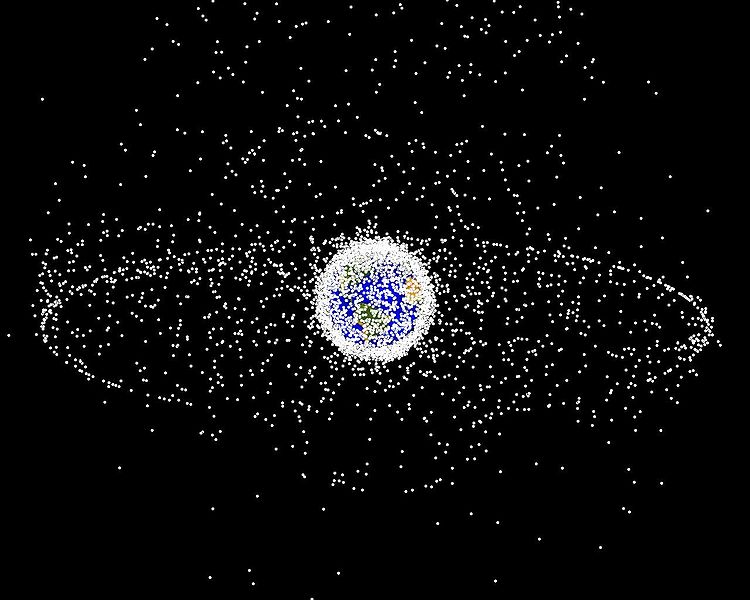
The space around Earth is a lot less empty than it used to be.  With hundreds of operational satellites, the International Space Station, manned space vehicles, and unmanned cargo ships, it seems things can get pretty crowded up there.  However, the vast majority of objects in orbit around Earth is not functioning satellites or housing for astronauts, it's space junk.


A map showing space debris populations in Earth orbit (NASA).

Space junk, or space debris, comes from a variety of sources.  Derelict satellites, discarded upper stage rocket engines, and fragments from explosions and collisions circle the world in both low Earth orbit and higher, geosynchronous orbits.  A satellite can remain in orbit for years after it stops functioning.  Vanguard 1, the first solar powered satellite, was put into a medium Earth orbit in 1958 and ceased communicating with ground controllers in 1964.  Yet, this now useless relic will remain in orbit for another 240 years.

The problem with all this space debris is that it is starting to pose a real threat to operational satellites and humans in Earth orbit.  The European Space Agency estimates there are over 600,000 objects in orbit that are larger than 1 cm.  And when traveling at over 23,000 kph, even a fleck of paint can cause a catastrophe when it collides with, say, the International Space Station.


A fleck of paint smashed into Challenger's window, causing this crater on shuttle mission STS-7 (NASA).

The situation isn't getting better any time soon, either.  Some experts now think that we have reached a tipping point, where there is now so much debris that objects will begin colliding with each other creating more debris at an exponential rate.  If that is indeed the case, it might soon be impossible for humans to safely travel into orbit, or even loft a satellite without the danger of it being obliterated in a vast sea of deadly space junk.  Indeed, just two years ago a defunct Russian satellite collided with a US communications satellite, destroying both and creating an extra 2,000 pieces of debris.

Mitigating the danger from space debris has already become a priority at NASA and in the international space community.  Ground based radar stations track much of the debris, but pieces under 10 cm can be difficult to detect with radar.  Knowing where the junk is can help astronauts be prepared for potential disasters, or help them know where to maneuver spacecraft to avoid a collision.  And now, after satellites have completed their operational lives, many are purposefully put into a decaying orbit that can cut down the time they will remain in orbit by decades.


The Goldstone antenna is capable of detecting debris as small as 2mm (NASA).

These steps may not be enough, however.  There are several plans in the works to actively "de-junk" space.  One plan, called the ElectroDynamic Debris Eliminator (EDDE), involves sending up cheap, lightweight satellites that use Earth's magnetic field for power and propulsion.  These satellites would be equipped with deployable nets to ensnare pieces of space junk, and drag the debris down to a decaying orbit.  Another plan involves moving debris into orbits that don't intersect with today's working satellites by using lasers.  A stream of photons impacting on a small piece of debris could move it up to 1 mm per second.  While that may not seem like a lot, over the course of several days that could add up to kilometers.

Whatever action is decided upon, certainly this clean-up effort will need to be an international one.  Dozens of nations operate satellites, and even the derelict satellites are still property of the nations that sent them up there.  Let's hope the space community comes to a swift decision, and implements a solution soon.  Space is risky enough as it is, removing the threat of space debris will be a big step toward sustaining a safer environment for satellites and astronauts.

Read more about space junk.