ISS

ISS
The final frontier.

Sunday, January 15, 2012

The End of Phobos-Grunt

The doomed Russian spacecraft, Phobos-Grunt has finally come crashing back to Earth.  I didn't want to admit to myself that it was going to end this way, but now there is no denying it.  Earlier today, Phobos-Grunt re-entered Earth's atmosphere, and while some of it burned up, debris did come down in the Pacific Ocean, west of Chile.  So ends the latest Russian interplanetary mission.


Artist's conception of the Phobos-Grunt spacecraft.

Phobos-Grunt was intended to fly to the Martian moon, Phobos, and return a soil sample via a small re-entry capsule.  It would have been the first return sample from the Mars system by any nation.  However, shortly after the November launch, ground controllers in Moscow lost contact with the spacecraft.  Apparently, two planned rocket burns never occurred, and the spacecraft never left Earth orbit.  For weeks, controllers tried to re-establish contact, and except for one short communication, contact was never fully regained.  Hope remained for some weeks that the spacecraft could be salvaged, but, clearly, that never happened.

Russia (and before them, the Soviet Union) has had a long history of mission failures to the red planet.  Of the nearly 20 missions Russia has aimed at Mars, none have been complete successes, and only a handful have partially succeeded.  The Phobos-Grunt disaster is reminiscent of the Mars 96 incident, where a complex Mars orbiter and lander failed to leave Earth's orbit and burned up over the Pacific.  This latest failure, coupled with a recent spate of other space failures, has Russia's government putting the pressure on those in the space industry.  President Medvedev even went so far as to threaten prosecution of engineers and scientists who work on failed missions.  Succeed or rot in prison - a truly sound policy!

Where Russia goes from here isn't yet clear.  Russia takes space exploration seriously, and despite this latest failure, I believe they will continue with interplanetary science missions.  There is some talk of the Russians being involved with the upcoming ExoMars mission.  ExoMars is a collaboration between the ESA and NASA, and would launch an orbiter to Mars in 2016.  That orbiter could be partially outfitted with Russian instruments and be launched atop a Russian Proton rocket.  A rover would follow in 2018, but it is not yet known if Russia would help with that part of the mission.


Stuck in orbit, Phobos-Grunt as seen from Earth (Ralf Vandebergh).

Russia is an important international partner in humanity's continued exploration of space.  With luck, they will rebound from this setback, and contribute on future missions to the red planet and beyond.

Wednesday, January 11, 2012

Planets of the Milky Way

A new study estimates that there may be as many as 160 billion planets in our Milky Way Galaxy.  That's about 1.6 planets per star, many more than were thought to exist just a few years ago.  Most of these worlds are thought to be rocky type planets, as opposed to gas giants.  Just how many of these planets could support life, however, remains to be seen.

Interest in planets outside of our solar system, known as exoplanets, has increased dramatically in the last few years.  The amazing success of NASA's Kepler mission has fueled much of the interest.  To date, the orbiting Kepler telescope has identified nearly 3000 exoplanets.  Kepler does this by measuring the slight decreases in the amount of light a star appears to emit when a planet passes between the star and the telescope.  This is called the 'transit method' of exoplanet detection.  After a candidate exoplanet is identified this way, scientists employ ground based telescopes to back up Kepler's findings.  It is only after this that an exoplanet can be confirmed to exist.  Around 700 of Kepler's candidate exoplanets have been confirmed, and it is estimated that up to 80% of all candidates will indeed turn out to be exoplanets once further observations are carried out.


Artist's depiction of the Kepler telescope (NASA).

After Kepler identifies a candidate planet, observing that world from ground based telescopes can be done in one of a few ways.  Scientists can measure small wobbles in a star's movement caused by the gravitational pull of planets orbiting the star.  This is called the 'radial velocity' method.  Both this and the transit method are biased toward large planets that are close to their parent stars, however.  Another method that doesn't have the same bias is called 'gravitational microlensing.'  This is where a star is observed just as a closer body, such as another star, passes in front of it.  The gravity of the closer body bends and magnifies the light of the distant star, similar to a lens.  This can help resolve the relatively tiny exoplanets that may be orbiting the star.

The big question now becomes: Are these worlds habitable?  The Kepler telescope, by itself, cannot tell us this.  However, we can infer several things from Kepler's findings.  For life, as we know it, to exist, a planet must harbor liquid water.   For that to happen, a planet must be in its star's 'habitable zone'; a distance, particular to each star, where it is neither so cold that water freezes, nor so hot that water boils away.  Earth, for example, is right in our Sun's habitable zone.  Venus, with its 480 degree Celsius surface temperature and runaway greenhouse effect, is just a little too close to the Sun to be in the habitable zone.  Kepler has already identified exoplanets that are in their habitable zones, and is sure to observe more in the coming years.  It will be up to other telescopes, like the as yet to be launched James Webb Space Telescope (JWST), to probe deeper into these potentially life harboring exoplanets.  JWST will have the ability to measure the atmospheres of exoplanets, and depending on the composition, that could reveal whether or not life exists on those planets in any great quantity.


Artist's depiction of the James Webb Space Telescope (NASA).

The Kepler telescope is confirming what scientists have only been able to speculate up to now; that our galaxy is filled with stars that have planets orbiting them, just like our own solar system.  The wealth of knowledge Kepler is bringing to humanity is astounding.  Hopefully, these discoveries will drive home the point that space based astronomy is an important and vital resource in unlocking the mysteries of our universe.

Monday, January 2, 2012

China's Space Plans

Last week, the Chinese government released a 17 page white paper document entitled, "China's Space Activities in 2011."  The paper is a brief summing up of the last five years in Chinese space activities, and a preview of what to expect in the next five year space program.  While the paper isn't mind blowing in its scope or material, it does touch on some interesting points.

The accomplishments of the Chinese space program have been impressive in the last five years, and the paper focuses on the most noteworthy achievements.  Since 2006, the Long March series of rockets, China's workhorse, has had 67 successful launches, making it one of the world's most reliable launch systems.  In 2007 and 2010, China launched Chang'e-1 and Chang'e-2, respectively, which marked the nation's first serious foray into deep space exploration.  Both spacecraft successfully orbited, mapped, and studied the Moon. In 2008, China successfully launched three men aboard Shenzhou-7, a mission that saw the country's first spacewalk.  And, most recently, China launched its first space lab, Tiangong-1, and successfully remotely docked a Shenzhou spacecraft with the orbiting lab.  The paper also mentions a few scientific accomplishments, like experiments in physics and materials sciences.

Chinese astronaut, Zhai Zhigang, waves to the camera during his 2007 spacewalk (BBC).


The paper goes on to lay out a general plan for China's space program for the next five years.  A continuation of the space lab program, in preparation for a full-fledged space station is highlighted.  This next year will see another unmanned docking with Tiangong-1, as well as one manned mission to the lab.  The Chinese lunar program will move forward as well, with a plan to do a soft landing, followed by a lunar rover, and culminating in a soil return mission.  China will also develop several new rockets in its Long March series, including a "heavy lift" variant which proposes to launch 25 tons into low Earth orbit.


Possible configurations of the proposed Long March 5 family of rockets (Jirka Dlouhy).

One of the surprising things about the document is how much emphasis is put on international cooperation.  Every international space agreement China has entered into is detailed, from commercial deals with the developing world, to multi-national science missions with Europe, to Russia's cooperation with China on their manned program.  This could be a sign that China is opening up more, and by highlighting the work they have already conducted with other nations, they hope to cozy up to bigger space partners (maybe the US?).

Not surprisingly, there are some inconsistencies with what the Chinese government says, and what it does.  The paper highlights China's efforts to mitigate and track space debris.  However, in 2007 the Chinese tested an anti-satellite weapon, destroying one of their own aging weather satellites.  This incident created over 2,300 pieces of trackable space debris.  While this stunt may have demonstrated China's satellite killing ability to the world, it created more space debris than any other single event in history.  Debris from this incident has already threatened the ISS once, and will continue to be a problem for all space faring nations decades to come.

Propaganda aside, China is indeed pushing forward in all aspects of their space program, and this latest document is an interesting glimpse of where China is headed in space.  Let's hope they keep to their commitment of greater international cooperation, an increase in space science, and a reduction in dangerous space debris.

Read the full text of the white paper, here.

Thursday, December 22, 2011

Organics on Pluto

Pluto may have been downgraded to 'dwarf planet' status, but there are still big discoveries to be made on the icy world.  A recent study using the Hubble Space Telescope has detected possible evidence of complex organic molecules on Pluto's surface.  Pluto is known to harbor ices of methane and nitrogen, and when high energy cosmic rays interact with these ices, organics can form.  And while it isn't likely that Pluto has any Little Green Men, organic molecules are the building blocks for life as we know it.  It's also these organics that may give the Plutonian surface its ruddy color.


Little is known about the surface of distant Pluto (NOAA).

Pluto is a member of the Kuiper Belt, a ring of frigid asteroids and dwarf planets that extends from just beyond the orbit of Neptune, at 30 AU, out to about 50 AU (1 Astronomical Unit, AU, is equal to the distance from the Earth to the Sun, or about 150 million km).  There are more than 70,000 documented Kuiper Belt objects (KBOs), and several of the larger objects seem to share Pluto's reddish surface, indicating that organics may be prevalent in the distant reaches of the solar system.

Observations by the Hubble Space Telescope aren't the only way scientists are keeping tabs on Pluto and other KBOs.  NASA's New Horizons spacecraft is set to flyby Pluto in 2015.  Launched in 2006, New Horizons left Earth with the fastest ever launch speed of a man made object, at over 58,000 km/h.  It will be the first spacecraft to visit Pluto, and its closest approach will put it just 12,500 km above Pluto's surface.  New Horizons will then continue on its journey farther into the Kuiper Belt.

A thorough investigation of the Kuiper Belt is necessary to fully understand how our solar system formed.  Identifying locations of organic molecules, and studying how those molecules came to be, will also help in explaining how life arose on our own planet. It may also give clues as to where to look for life on other worlds or in other star systems.  With luck, further Hubble observations and the New Horizons spacecraft will reveal more about mysterious Pluto.

Friday, December 9, 2011

Europa!

NASA scientists recently announced they are planning a mission to Jupiter's icy moon, Europa, to find out if the distant moon is capable of supporting life.  While the mission is only in the concept stage, and is years away from realization, it shows that NASA is seriously thinking beyond Mars for the potential of life in the solar system.


Jupiter's icy moon, Europa, as seen from the Voyager spacecraft (NASA).

The proposed mission would launch two landers in 2020, and each would be laden with 36 kg of scientific equipment.  Included would be seismometers to measure any seismic activity on the moon, as well as spectrometers to search for organic molecules and the building blocks of life.  It has been speculated that Europa might harbor life, as the moon is covered in a thick crust of ice, and some miles down may in fact have a giant ocean of liquid water.  Just last month scientists discovered there may even be shallow lakes of water right beneath the surface.

Any mission to the Europan surface would have to be a relatively quick one.  Jupiter constantly bombards the moon with massive amounts of radiation.  Without the aid of radiation shielding, a lander couldn't be guaranteed to last more than seven days on the surface of Europa, and mission scientists aren't interested in sacrificing scientific equipment for heavy radiation shielding.  Still, seven days could provide a bounty of information on the mysterious world.


Artist's conception of a lander approaching the Europan surface (futureplanets.blogspot.com)

With a potential price tag of $800 million, this proposed Europa mission would likely cost more than NASA's recent, inexpensive, New Frontiers missions, which usually run around $400 million.  However, it would likely be less expensive than a so-called 'flagship' mission, which can run into the many billions of dollars.  There had been some talk of a potential flagship Europa orbiter mission, in which NASA would have teamed up with the European Space Agency for two Jupiter system orbiters.  However, recent budget constraints have most likely killed the American portion of that mission (the ESA may continue the project without NASA support).

A mission to explore the habitability of the far flung moons of our solar system is inevitable.  Europa and Ganymede both contain large amounts of water, and Jupiter's gravitational pull may create enough friction to keep some of that water in a liquid state.  Saturn's moon Titan, which was visited by the Huygens probe back in 2005 as part of the Cassini mission, is also a prime candidate for life.  Titan is covered in lakes of hydrocarbons, and indeed has an entire climate system based on liquid methane and ethane in which life forms might flourish.  I do hope that NASA makes visiting these worlds a priority, as unlocking their secrets will undoubtedly lead to a greater understanding of how our solar system formed, and possibly reveal whether or not life ever evolved on a planet other than our own.

Thursday, November 24, 2011

Phobos-Grunt Update - Promising News!

After more than two weeks stuck in Earth orbit, Russian flight engineers have finally made contact with the Phobos-Grunt spacecraft.  In a last ditch effort to save the 165 million dollar mission, the Russian space agency, Roskosmos, elicited the help of the European Space Agency and attempted to contact Phobos-Grunt using ground station antennas in Perth, Australia.  Miraculously, contact with the ill-fated spacecraft was established.  After several more passes over Perth, telemetry data was downloaded, and Russian engineers began deciphering the coded data.  Why, exactly, contact couldn't be made up until now isn't yet known, however it appears that the solar arrays of the spacecraft were in an optimal position while it was over Perth, and the extra energy generated allowed for Phobos-Grunt to communicate with Earth.  It still remains unclear what exactly caused the failure of the orbital engine burns, but further analysis of the data and continued contact with the spacecraft will most likely allow engineers to discover the problem.


Phobos-Grunt mission poster (Roskosmos).

Now the question becomes - if Phobos-Grunt can be saved, what to do with it?  The window to send the spacecraft to Mars appears to now be closed, although some debate on this matter remains.  If, indeed, it is too late to try for Mars, the mission may still be salvaged.  One option is to keep the spacecraft in Earth orbit for another two years, until the launch window for Mars again opens, and then send it on its way.  Although, there may not be enough fuel on board for this.  The other option is to completely change the mission objectives, and send the spacecraft to a near Earth asteroid.  The parameters of the mission would essentially be the same, as Phobos is thought to be an asteroid that was captured by Mars's gravity.  So landing on an asteroid, and launching the soil recovery capsule, wouldn't be outside the abilities of the spacecraft.  However, it would take new software and new calculations, and a completely new flight path - and that too could take some time.  Of course any of these options require that enough data can be downloaded from the spacecraft to isolate the initial problem, and then that problem must be fixed.

If Phobos-Grunt cannot be salvaged, it will burn up upon re-entry into Earth's atmosphere on or about January 15th, 2012.  Read more here.

Sunday, November 20, 2011

New Moon Map

This week, scientists released the best topographical map of the Moon ever created.  The new map, which covers 98.2 percent of the Moon's surface, gives detailed topo information down to the 100 meter scale.  This is an impressive feat that could only have been accomplished with NASA's Lunar Reconnaissance Orbiter (LRO).


The new, detailed, topographic map of the moon (NASA Goddard).

LRO, launched in 2009 and costing a little over $500 million, has been a resounding success.  In addition to the camera and on board altimeter that helped create the new topographic map, LRO has a number of other high-tech devices; the Diviner Lunar Radiometer Experiment (DLRE) has created a thermal map of the Lunar surface, while the Cosmic Ray Telescope for the Effects of Radiation (CRaTER) is helping to determine how detrimental cosmic rays might be to biological organisms on the Moon's surface.

The completion of this map comes at an opportune time.  Early next year, NASA's twin GRAIL spacecraft will arrive in lunar orbit, and create the most accurate gravity map of the Moon to date.  This combination of topographical, thermal, and gravity mapping will give scientists truly new insights into all aspects of the Moon's formation and subsequent development.

It's good to see that while NASA's manned program is shifting away from the Moon toward asteroids and Mars, a healthy robotic exploration of the Moon continues.  And it isn't just NASA that shows continued interest in the Moon.  As I've discussed before, China has distant plans to land human beings on the Moon - and while that might be a while off, they have launched two orbiters to our natural satellite, Chang'e 1 and Chang'e 2, as part of their own robotic exploration program.  India, also, launched and operated the highly successful Chandrayaan-1 spacecraft in orbit around the Moon.

There are also a number of private companies and individuals showing interest in lunar exploration.  Bigelow Aerospace wants to build inflatable habitats on the surface of the Moon to compliment their planned inflatable orbital station.  Shackleton Energy is looking into the possibility of extracting hydrogen and oxygen from the lunar surface, processing it into fuel, and building a fuel depot in lunar orbit.  And the Google Lunar X Prize, a $30 million contest to put a rover on the Moon, has some serious entries from cutting edge engineering teams from across the nation.  These are all ambitious plans, but the greater number of entities interested and involved in lunar exploration, the more the cost will come down, and the greater the chances of success of one or more of these projects.


Artist's rendition of a Bigelow Aerospace lunar base (Bigelow Aerospace).

Lunar exploration will go forward, and NASA's continued remote exploration of our closest neighbor will be absolutely vital.  My hope is that lunar programs don't lose steam with the coming robotic and manned explorations of other bodies in the solar system.

Saturday, November 12, 2011

Herman Cain Complains

Earlier today, Republican presidential hopeful Herman Cain gave a speech to a group of Young Republicans in which he complained about President Obama's decision to end the Space Shuttle program.  Wait, what!?  Let's be absolutely clear, here - George W. Bush ended the Space Shuttle program.  I don't know if that is a simple misunderstanding of facts, or if Cain is trying to re-write history - either way it doesn't impress me.


The Space Shuttle Discovery in low Earth orbit (NASA).

However, the real issue here isn't who canceled the shuttle program.  The real issue is that people are still up in arms over it.  And it isn't just Herman Cain that's whining.  Just last month, Gene Cernan, the last man to walk on the Moon, testified before Congress that we should take the Space Shuttle out of retirement.  With all due respect to Mr. Cernan, that's completely impractical, and would be a giant step backward from the direction NASA is headed.

Don't get me wrong, the Space Shuttle is an amazing machine.  If I had my way, we'd have a fleet of ten space shuttles, an orbiting Moon station, and permanent mining colonies on Mars.  Unfortunately, there aren't unlimited government funds for space exploration, and I think that's where some people get confused.  In order for NASA to begin human exploration of the solar system beyond Earth and the Moon, other manned programs had to be cut.  In 2005, 30% of NASA's budget, 5 billion dollars, was spent on the Space Shuttle.  The Space Launch System and the Orion capsule, NASA's planned rocket and vehicle to take humans into deep space, will cost between $3 and $4 billion per year for the next 6 years, and probably continue at that rate for the life of the program.  So, there's the problem.  Unless Congress and the American people are willing to spend an extra $4 billion per year on NASA's manned operations, there is no way that both the Space Shuttle and a deep space exploration program could both survive.

It's a question of where NASA should focus its limited resources.  And the solution that NASA and the government came up with is a good one.  Cancel the shuttle and let NASA focus on putting men on asteroids and Mars, and let commercial entities pick up the burden of ferrying astronauts to low Earth orbit.  It's true there will be a gap of several years in American made manned spacecraft.  It's also true that none of the spacecraft currently in the pipeline will have the massive external cargo bay that the shuttle had.  However, companies like Boeing, SpaceX, and Orbital Sciences are showing real promise in realizing commercial spacecraft, both for cargo and astronauts.


Artist's depiction of SpaceX's Dragon capsule (Getty).

The Space Shuttle was the right spacecraft at the right time.  It isn't the only spacecraft for all time.  For American spaceflight to move forward, we need to stop looking backward and we need to stop the complaining.  SLS is the rocket of the future.  Orion is the vehicle that will take humans to an asteroid.  SpaceX's Dragon capsule will be ferrying cargo and people to the International Space Station.  Get used to it.

Friday, November 11, 2011

NASA Moves Forward on Manned Spaceflight

NASA's plans for human spaceflight got a shot in the arm this week.  A test flight of the Orion Multi-Purpose Crew Vehicle has been proposed for 2014.  Exploration Flight Test 1, or EFT-1, will launch an unmanned Orion into Earth orbit to test critical systems and re-entry at a high velocity.  NASA had previously stated that an unmanned Orion test flight could occur in 2017, so for once in the history of spacecraft development things are actually ahead of schedule.


Still from a NASA animation depicting the Orion capsule detaching from the upper stage of a rocket (NASA).

The Orion capsule is being developed by Lockheed Martin, and it appears to be NASA's choice for the next phase of human exploration of the solar system.  Originally designed as part of the now defunct Constellation program, Orion got a second chance at life, and now looks like it may serve a dual role as a deep space exploration vehicle, as well as possibly doing some ISS taxi/escape boat service.

Eventually, Orion will ride atop NASA's planned Space Launch System (SLS) rocket.  However, as the SLS probably won't be ready for a test flight in 2014, EFT-1 will take place using an existing commercial heavy-lift rocket.  While no existing American made commercial rockets are man-rated, a Falcon-9 or a Delta-IV could launch an unmanned Orion capsule to the high orbit required of the test flight.


Artist's depiction of the SLS (NASA).

Speaking of SLS, NASA is making headway in that department as well.  This week NASA successfully tested the powerful J-2X engine at Stennis Space Center in Mississippi.  The J-2X will be the engine on the second stage of the SLS rocket.  When complete, the SLS will be the most powerful rocket ever built, with the ability to lift over 130 tons into orbit.  It is this massive rocket that will one day be lifting the Orion capsule out of Earth's orbit entirely, on trips to the Moon, an asteroid, or Mars.

Wednesday, November 9, 2011

Phobos-Grunt Crisis

Russia's Phobos-Grunt mission is in dire straits.  As I wrote earlier, Phobos-Grunt is an ambitious mission.  Its main objective is to land on Mars's asteroid-like moon, Phobos, and return a sample of the surface back to Earth.  If successful, it will be the first direct sample return from the Mars system, and it will be Russia's first successful planetary mission in decades.  "If successful," being the key term, there.

The mission began with a perfect launch aboard a Zenit rocket at about noon PST, on November 8th.  Serious problems arose shortly thereafter.  After achieving the proper parking orbit, Phobos-Grunt was to make two engine burns, which would send the craft on its way out of Earth orbit, and toward Mars.  When neither rocket burn occurred, the Russian space agency, Roskosmos, lost contact with the spacecraft, and its orbit was unknown.


The Zenit rocket carrying Phobos-Grunt spacecraft, shortly before launch (Roskosmos).

There was no contact with Phobos-Grunt until today, when, with the help of US military tracking stations, Roskosmos finally determined exact orbital parameters of the craft, and they were able to download telemetry data.  Once this data is processed and analyzed, it should be clear what the problem with the craft is, and whether or not it can be fixed. 

There are, basically, two possible scenarios.  The problem with Phobos-Grunt could be electrical or mechanical, meaning the on board computers are functioning, and gave proper commands to the engines, but the engines failed to fire because the are physically unable to do so.  The other scenario is that the computer software is faulty.  It may be that the proper commands were simply never given by the computer, and the engines never got the go-ahead to burn.  If the problem is mechanical or electrical, the mission is done.  Phobos-Grunt will remain in orbit for a week or two, then plummet into Earth's atmosphere and burn up in a fiery repeat of the Mars 96 mission.  However, if the software is the problem, it is still possible for Roskosmos to upload new software that can give correct commands to the engines, and the mission might still make it to Mars after all.

Downloading the telemetry data from the craft is a good first sign that salvation may be possible.  Communication with Phobos-Grunt is vital if the mission is to move forward.  Let's keep our fingers crossed that nothing else goes wrong, and that in a few years scientists will be pouring over regolith samples from Phobos!

Check back here for all your Phobos-Grunt updates.  Also, check out russianspaceweb.com

Wednesday, November 2, 2011

China Succeeds in Orbital Docking

Chalk up another high profile success for the Chinese Space Program.  Earlier today, the unmanned Shenzhou-8 spacecraft successfully docked with China's first orbiting space lab, Tiangong-1.  This docking was performed automatically, which means there was no human control over either spacecraft during the last 50 kilometers of approach.  An impressive feat, by any standards.


Chinese television documented the automated link-up (CNTV/CCTV).

Shenzhou-8 will spend the next 12 days docked to Tiangong-1.  The spacecraft will then undock, and then re-dock to prove all systems are functioning properly.  After spending two more days attached, the two craft will separate for the last time, and Shenzhou-8 will head back to Earth.  China plans on sending two more Shenzhou spacecraft to dock with the orbiting lab, one of which will carry a crew of three taikonauts (Chinese astronauts) for a short stay aboard Tiangong-1.


Artist's conception of the Shenzhou-8/Tiangong-1 docking.

With this automated docking, China takes another step on its ambitious path of space exploration.  What makes this even more impressive is that only a handful of nations have accomplished this task.  The US, Russia, Japan, and the European Space Agency have all developed this technology on their own, and each has successfully sent craft to the International Space Station.  Now that China has demonstrated its ability to dock spacecraft automatically in orbit, it will be possible for the construction of a full-fledged Chinese space station to begin.  China plans to begin construction on a manned station, comparable to the Soviet space station Mir, by the beginning of the next decade.

I, as always, applaud China's progress in space exploration.  However, China's success in space flight always stirs up worries here at home about America's perceived decline as the preeminent space power.  Just last month, private space entrepreneur and founder of Bigelow Aerospace, Robert Bigelow, claimed that China has the ambition and ability to lay ownership to large swaths of the Moon.  Ambition, perhaps, but the ability to land people on the surface of the Moon is in China's distant future, if at all.  As it is, China simply doesn't give their various space agencies the funding they need to develop a truly heavy lift rocket capable of putting large payloads into Lunar orbit.  Add that to the fact that whatever China does in manned spaceflight, they'll being doing it alone.  Their manned program remains shrouded in military secrecy, sequestered from the openness of the international scientific community.  It is, ultimately, an unsustainable path that is doomed to fail.  Tourists will be spotting craters from lunar orbit in spacecraft built by Boeing and SpaceX long before China lands people on the Moon - so don't lose any sleep.

Saturday, October 22, 2011

Russia Sets its Sights on Phobos

Russia is finally getting back into the game - the interplanetary space exploration game, that is.  Next month, Russia is set to launch their first interplanetary probe in 15 years.  And if all goes according to plan, it promises to be an extraordinary mission.  The Phobos-Grunt spacecraft consists of a lander that also acts as an orbiter.  Once in Martian orbit, the spacecraft will study both Mars and Phobos for several months, and after a suitable landing place has been found, it will descend to the surface of Phobos.  Once there, it will conduct a thorough scientific investigation of the surface and then collect a soil sample, seal the sample in a return capsule, and blast it back to Earth.  A sample return mission has never been attempted for Mars or either of its moons, so this is really an ambitious and exciting mission.


The Phobos-Grunt spacecraft.

Mars has two moons, Phobos and Deimos.  Both are tiny, and are thought to be asteroids that were captured by Mars's gravity.  By contrast, our own Moon was most likely formed when a planetoid object collided with the early Earth, and the debris coalesced into the Moon.  A soil sample from Phobos will undoubtedly confirm the asteroid-capture theory.


Phobos as seen from the Mars Express spacecraft (ESA).

Russia's last interplanetary mission, Mars 96, ended in complete disaster.  Planned to be an orbiter and two landers, Mars 96 failed to escape Earth orbit, and burned up over the Pacific.  If Phobos-Grunt can succeed, it will certainly be a feather in the cap of Russia's space agency, and a leap forward in our understanding of how the Mars system formed.  France's space agency, CNES, is partnering with Russia on Phobos-Grunt, and has contributed some of the scientific instrumentation aboard the spacecraft.


Artist's rendition of Phobos-Grunt lander with sample return capsule detached at top.

Along for the ride with Phobos-Grunt is a small, Chinese satellite, named Yinghou-1.  It will be China's first spacecraft to the Red Planet.  It will be released into Martian orbit, and have a scientific mission to study the Martian gravitational and magnetic fields for about a year.

Read what NASA has to say about Phobos-Grunt, here.

Sunday, September 11, 2011

Twin GRAIL Probes Head to The Moon

NASA is headed back to the Moon!  Not with people, mind you, but with two very high tech spacecraft.  Yesterday morning, the GRAIL (Gravity Recovery and Interior Laboratory) mission successfully launched from Cape Canaveral atop a Delta 2 rocket.  The mission involves two nearly identical spacecraft, Grail-A and Grail-B, which are now headed, at a slow pace, to the Moon.


The Delta 2 rocket carrying the GRAIL spacecraft rises from Cape Canaveral (NASA).

The GRAIL mission is a fascinating one.  Its purpose is to construct a 'gravity map' of the Moon.  The 'gravity map' will tell scientists what parts of the Moon have a greater or weaker gravitational pull.  Knowing this information will not only reveal the make-up of the Moon's interior, but will help future spacecraft enter into more exact orbits, and aid in the landing of lunar probes.  As part of NASA's Discovery Program (promoting science missions on the cheap), costs were kept to a minimum, and that meant keeping the washing machine-sized spacecraft light on fuel.  The GRAIL craft will take nearly four months to reach the Moon - a trip that the Apollo missions made in three days.  As they approach the Moon, around New Year's Day, the spacecraft will maneuver into tandem orbits, and fly the duration of their mission in formation.  By keeping in constant radio contact with one another, and Earth based antennae, even the slightest perturbations in the crafts' orbits will be detectable.  The greater the disturbance of the orbit, the greater the gravitational pull any given point on the lunar surface is exerting on the spacecraft.  Voila, you've got a gravity map of the Moon.

Okay, so it isn't quite that simple, but that's the basic premise.  The actual maneuvering of the spacecraft into their exact orbits will be an unprecedented feat.  Two craft have never been put into tandem orbits like this around another planet, which is another reason the craft are taking their time to get to the Moon.  Small adjustments to the crafts' trajectories will be made over the coming months, so that when they reach lunar orbit, they will be ready for their formation flying.


An artist's rendition of the GRAIL spacecraft communicating with each other and the Earth (NASA/JPL).

Each GRAIL spacecraft will also be equipped with a MoonKAM (Moon Knowledge Acquired by Middle school students).  Students participating in the program will be able to pick out features on the lunar surface, and then photograph them using the cameras.  This is the first time NASA has launched an instrument with the express purpose of public outreach.

The successful launch of the GRAIL mission comes at a fortuitous time.  In the past three weeks there have been three major spacecraft launches; two by Russia, and one by China.  They all failed.  Not to mention the recent failure of a suborbital launch test by private space firm, Blue Origin.  I don't take pleasure in any of these failures, but it is nice to be reminded of NASA's dominance.  Even in the face of fickle funding, and sometimes waning public interest, NASA continues to succeed.  They employ some of the best engineers and scientists in the world, and NASA's budget is almost equal to the budgets of every other national space agency combined.  NASA leads in space science and in achieving amazing technological feats, and that isn't changing anytime soon.

Saturday, September 3, 2011

Space Junk Threatens Man and Machine

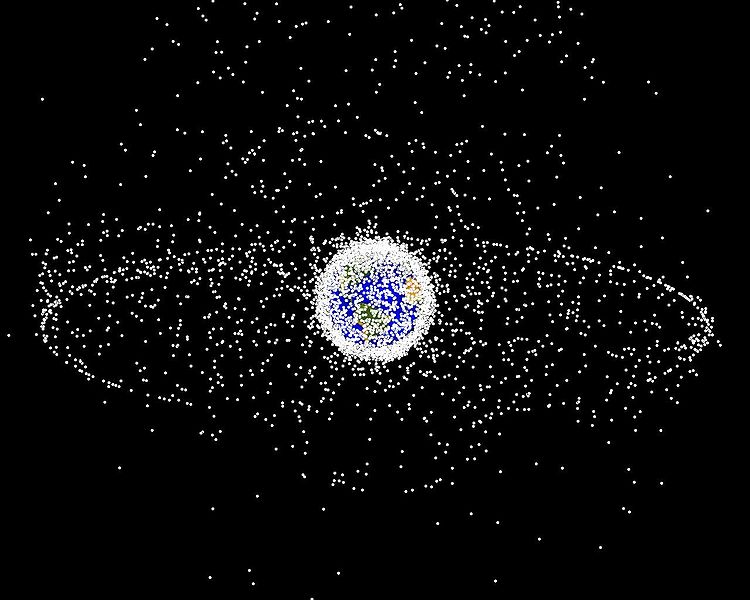
The space around Earth is a lot less empty than it used to be.  With hundreds of operational satellites, the International Space Station, manned space vehicles, and unmanned cargo ships, it seems things can get pretty crowded up there.  However, the vast majority of objects in orbit around Earth is not functioning satellites or housing for astronauts, it's space junk.


A map showing space debris populations in Earth orbit (NASA).

Space junk, or space debris, comes from a variety of sources.  Derelict satellites, discarded upper stage rocket engines, and fragments from explosions and collisions circle the world in both low Earth orbit and higher, geosynchronous orbits.  A satellite can remain in orbit for years after it stops functioning.  Vanguard 1, the first solar powered satellite, was put into a medium Earth orbit in 1958 and ceased communicating with ground controllers in 1964.  Yet, this now useless relic will remain in orbit for another 240 years.

The problem with all this space debris is that it is starting to pose a real threat to operational satellites and humans in Earth orbit.  The European Space Agency estimates there are over 600,000 objects in orbit that are larger than 1 cm.  And when traveling at over 23,000 kph, even a fleck of paint can cause a catastrophe when it collides with, say, the International Space Station.


A fleck of paint smashed into Challenger's window, causing this crater on shuttle mission STS-7 (NASA).

The situation isn't getting better any time soon, either.  Some experts now think that we have reached a tipping point, where there is now so much debris that objects will begin colliding with each other creating more debris at an exponential rate.  If that is indeed the case, it might soon be impossible for humans to safely travel into orbit, or even loft a satellite without the danger of it being obliterated in a vast sea of deadly space junk.  Indeed, just two years ago a defunct Russian satellite collided with a US communications satellite, destroying both and creating an extra 2,000 pieces of debris.

Mitigating the danger from space debris has already become a priority at NASA and in the international space community.  Ground based radar stations track much of the debris, but pieces under 10 cm can be difficult to detect with radar.  Knowing where the junk is can help astronauts be prepared for potential disasters, or help them know where to maneuver spacecraft to avoid a collision.  And now, after satellites have completed their operational lives, many are purposefully put into a decaying orbit that can cut down the time they will remain in orbit by decades.


The Goldstone antenna is capable of detecting debris as small as 2mm (NASA).

These steps may not be enough, however.  There are several plans in the works to actively "de-junk" space.  One plan, called the ElectroDynamic Debris Eliminator (EDDE), involves sending up cheap, lightweight satellites that use Earth's magnetic field for power and propulsion.  These satellites would be equipped with deployable nets to ensnare pieces of space junk, and drag the debris down to a decaying orbit.  Another plan involves moving debris into orbits that don't intersect with today's working satellites by using lasers.  A stream of photons impacting on a small piece of debris could move it up to 1 mm per second.  While that may not seem like a lot, over the course of several days that could add up to kilometers.

Whatever action is decided upon, certainly this clean-up effort will need to be an international one.  Dozens of nations operate satellites, and even the derelict satellites are still property of the nations that sent them up there.  Let's hope the space community comes to a swift decision, and implements a solution soon.  Space is risky enough as it is, removing the threat of space debris will be a big step toward sustaining a safer environment for satellites and astronauts.

Read more about space junk.

Sunday, August 28, 2011

Oregon Company Flies High

It isn't often that Oregon makes space news, so I found this to be a real treat.  NASA recently awarded contracts to seven private companies to carry scientific payloads to suborbital space.  One of those companies, Near Space Corporation (NSC), is based out of Tillamook, Oregon.  Okay, so they aren't exactly going into space - NSC builds and launches high altitude balloons.  Very high altitude.  They can launch a payload of over 1300 kg up to an altitude of about 40 km.  That's 130,000 feet.  That's above 99.9% of Earth's atmosphere, and while it isn't quite space, it is high enough to interest NASA.


Near Space Corporation preparing for a balloon launch near Tillamook, Oregon (NSC).

NSC has, in fact, already done some work for NASA, the Jet Propulsion Lab, and the National Oceanic and Atmospheric Administration.  They've done high altitude payload drops to simulate the thin Martian atmosphere, and are even designing a dirigible for use in the methane rich atmosphere of the Saturnian moon, Titan.

And while the other companies that NASA is contracting (including Virgin Galactic and Masten Space Systems) operate rockets to launch payloads to higher, suborbital space, putting scientific equipment on balloons does have its advantages.  Balloons can remain aloft for days at a time, allowing for a longer exposure to near space conditions than a single rocket launch, and for a fraction of the cost.

I'm glad Oregon is finally getting into the space mix.  Hopefully, NSC will allow NASA to get some science done on the cheap, while bringing a little attention to the Beaver State.  With luck, this will be just the beginning of Oregon's role in the burgeoning private space industry.

Saturday, August 27, 2011

The James Webb Space Telescope

The James Webb Space Telescope (JWST for short) has been making headlines lately, and for all the wrong reasons.  Recently, the House Appropriations Committee explicitly recommended the cancellation of the project, due to massive cost overruns.  It was revealed that the final cost of the telescope will be $8.7 billion - that covers the telescope's development, launch, and operation for five years in Earth orbit.  That is nearly four billion dollars more that was originally slated for the project.  That's a lot of money.  So what is the JWST, and why should we pay so much for it?


Artist's rendition of the James Webb Space Telescope (NASA).

The JWST, which was initially planned in 1996, is the heir apparent to the world's current most dazzling space telescope, the Hubble.  Named after a former NASA administrator, JWST promises to be the top of the line space telescope for the 21st century.  It will have four state-of-the-art instruments that will operate mostly in the infrared range, with some limited capability in the visible range of the spectrum.  It's primary mirror will be 6.5 meters in diameter; large enough to see back to nearly the beginning of the universe.  It will be the most powerful and sophisticated space telescope ever to fly.  That is, if it ever gets off the ground.

The problem comes in the crippling cost overruns the project has incurred over the years.  Despite the cooperation of the European Space Agency, the Canadian Space Agency, and Northrup Grumman, NASA is still bearing the brunt of the cost.  Several new technologies have been invented specifically for the JWST, including ultra-lightweight beryllium optics, and a cryogenic cooler that will keep the IR detectors as cold as 7K.  However, with a launch date that is still 7 years off, it's making congress antsy that they may be throwing money away.

JWST might get a reprieve, however.  Despite Congress wanting the project canceled, money may be moved around in NASA itself, to further fund the project.  Of course, that might mean scaling down some other missions, or putting them off until after JWST is launched.  JWST is what NASA calls a flagship mission, one that will bring not only science, but prestige, back to the agency, and it is likely to get priority over smaller missions.

Cost overruns aside, JWST needs to be launched.  The Hubble Space Telescope has been an amazing machine that has brought the edges of the universe to the coffee tables of people's homes.  It has conducted, and continues to conduct, amazing science, but it is decades old, and its days are numbered.  Another telescope, on the grand scale of Hubble, is needed if we are going to further our understanding of the origins of our universe.  Let's bite the bullet, fund JWST, and continue to push the envelope of human knowledge.

Read more about the James Webb Space Telescope.

Friday, August 19, 2011

Video: Spectroscopy and Alien Life

I was recently came across this video at ted.com, and it's very fascinating.  Garik Israelian gives a talk on how he is using spectroscopy to determine the composition of the atmospheres of stars, and how that could lead to the discovery of alien life.  Watch the video, it's quite interesting!

Tuesday, August 16, 2011

China On the Rise

China's space program is making waves once again.  It is expected that before the end of this month, China will launch their first space lab, Tiangong 1.  Weighing in at 8 tons, Tiangong 1 is small by space lab standards (The U.S.'s Skylab of the 1970's was over 80 tons, and the ISS weighs in at a whopping 450 tons!), however, it does represent a technical achievement.  While not a "space station", in the strict sense, the single module Tiangong 1 will orbit for several years, and be a platform for both robotic and manned missions to practice docking procedures.  The lab will also host at least two crews for several weeks at a time.  The knowledge gained from the Tiangong 1 missions will serve China well when they develop a full fledged space station sometime in the early 2020s.


Artist's rendition of a Shenzhou spacecraft (left) docked with Tiangong 1
(Credit: China Astronaut Research and Training Center).

Certainly, Tiangong 1 showcases China's ever increasing ability in the realm of manned space flight.  And coming on the heels of the retirement of the US Space Shuttle, it might be easy to think that China will soon overtake America in space.  We must remember though, China has only launched three manned space missions in the past 8 years.  And while Tiangong 1 is a significant achievement, it is a step that the US and Russia took and surpassed nearly half a century ago.  To be clear, Tiangong 1 does not represent a threat to Western supremacy in space.

Indeed, the very idea of a China-US space race is highly unlikely, even in the distant future.  First off, manned space flight is no longer the endeavor of just one or two nations.  It has been completely internationalized.  We have American, Russian, Spanish, Japanese, and every other nationality you can think of, riding Russian rockets to the International Space Station.  As far as most space faring nations are concerned, the way forward is through international cooperation.  If China is vying for a No.1 position, they will be taking on the rest of the world.  That isn't something that China can afford to do, at this point.  And, in fact, China would benefit immensely from distancing their military from their manned space missions, and opening up to a more international approach.

To show that China isn't a one trick pony, they successfully launched a new ocean observing satellite this week.  The Haiyang 2A satellite will replace older ocean observing satellites, and is equipped to monitor currents, surface winds, and other aspects of the maritime environment.  While the satellite's primary function will be to serve as an aid to shipping in China's crowded harbors, its suite of scientific instruments are a positive sign in China's move toward getting real science done in space.


A model of Haiyang 2A on display in China.

While China has a long way yet to go, both technically and diplomatically, in space, I applaud their efforts.  I anxiously await the launch of Tiangong 1, as well as more Chinese scientific missions.

Read more here and here.

Friday, August 12, 2011

Dawn Spacecraft Working Hard at Vesta

NASA's Dawn spacecraft, which arrived at the asteroid Vesta last month, has officially started its science mission.  Dawn will study the asteroid belt's second largest asteroid from an orbit of about 2700 km, and over the next 20 days will map the entire surface using both images and a detailed spectral analysis.  This data will give scientists on Earth a better understanding of the formation of Vesta, and why it, and the larger asteroid Ceres, never fully developed into planets.


Dawn snapped this picture of Vesta from 41,000 km (NASA/JPL).

Scientists believe that Vesta accreted into a proto-planet between the orbits of Mars and Jupiter beginning about 10 million years after the formation of the solar system.  However, being so close to Jupiter may have disrupted Vesta's formation, leaving it with only enough material to reach a diameter of 530 km - far smaller than even Earth's Moon.

The Dawn spacecraft was launched in 2007 as part of NASA's Discovery Program, which aims to launch focused missions that are heavy on science and cost effective.  Thus far, Dawn has performed perfectly.  If all continues to go well, after a yearlong study of Vesta, Dawn will leave orbit of that asteroid and head to the even more massive dwarf planet, Ceres.  Ceres is also in the asteroid belt, and is believed to have formed under similar circumstances as Vesta.  Dawn should arrive at Ceres sometime in 2015.

Dawn in the clean room prior to launch (NASA).

The study of these asteroids comes at a good time.  Not only will the science gleaned from this mission help us understand the formation of our solar system, and possibly other solar systems, but NASA plans to send humans to an asteroid by 2025.  Studying the magnetic fields, gravitational pull, and geology of asteroids will no doubt come in handy to future human explorers of these rocky worlds.

Read more about the Dawn spacecraft, its science mission, and Vesta.

Sunday, July 10, 2011

Now That the Shuttle is Retired, What Next?

In 1969, the father of the American space program, Wernher von Braun, wrote an article entitled, "Now That Man Has Reached the Moon, What Next?"  In the article, von Braun gives specific details on where he believes space exploration will go in the decades following the successful lunar landings.  Von Braun speculates on everything from the proliferation of communication satellites, to manned missions to Mars and Lunar bases.  And while we haven't put a man on Mars yet, a great deal of von Braun's speculations came to pass.  Von Braun thought that one day such impressive feats as the launching of space based telescopes and unmanned missions to Mars would be commonplace, as indeed they are, today.


Wernher von Braun with an early lunar rocket design (AP).

While von Braun certainly had vision, he could not forsee the changing tide in the nation just after Apollo.  As soon as Neil Armstrong took his small step, plans were in motion to slash NASA's budget.  Many in congress and around the country simply saw no use for NASA after it accomplished the great task of beating the Soviet Union to the Moon.  So while von Braun saw no limits to what NASA was capable of in space, all the public saw was a bloated government agency without direction.

Yesterday saw the launch of the last Space Shuttle.  Shuttle Atlantis launched from Cape Kennedy with four astronauts, and will soon rendevous with the International Space Station.  After 135 launches, and thirty years, it is the end of an era.  Where NASA is now is not wholly unlike where it was after Apollo.  True, the Russians are now our allies in space instead of our rivals, but the risk of stagnation and loss of vision is the same.

Two days ago, NASA cheif Charles Bolden spoke at a press conference to assure the public that American manned space flight was, in fact, not ending.  Private companies will pick up NASA's slack to ferry astronauts to low-Earth orbit before too long, while NASA sets its sights on deep space exploration - a manned mission to an asteroid by 2025, and to Mars by the 2030's.  This is exactly the vision for space exploration that President Obama and NASA have laid out over the past couple of years.

As long as Congress follows through on funding NASA properly, and doesn't block the privatization efforts in spaceflight, I don't think the next decade will look like that which followed Apollo.  NASA will not stagnate.  It has myriad planned and ongoing science missions.  Missions like Dawn, that will study the asteroid Vesta and dwarf planet Ceres, and the planned GRAIL mission that will make the most accurate gravitational map of the Moon to date.  NASA has a clear path for manned exploration of deep space, as well.  Development continues on the spacecraft that will one day take astronauts far from Earth's orbit, the Multi-Purpose Crew Vehicle.  We are going to be okay.


Artist's conception of the Dawn spacecraft (NASA/JPL).

With luck, the future of space exploration will be as bright as Wernher von Braun had once speculated it would be.  Von Braun ended his article with this - "Exploration of space is the challenge of our day.  If we continue to put our faith in it and pursue it, it will reward us handsomely."

Read what's next for NASA, here.